Horse Boarding Contract Template - Free PDF, Word & Online Editor
Create a professional Horse Boarding Contract online. Customize horse details, boarding services, fees, feeding schedule, veterinary care, and stable rules, then download a printable PDF or Word document.
Horse Boarding Contract: What It Is and Why You Need One
If you own a horse and board it at a stable — or you run a stable that boards horses for others — a handshake agreement is not enough. A horse boarding contract is the document that protects both sides when things go well, and especially when they don't.
What Is a Horse Boarding Contract?
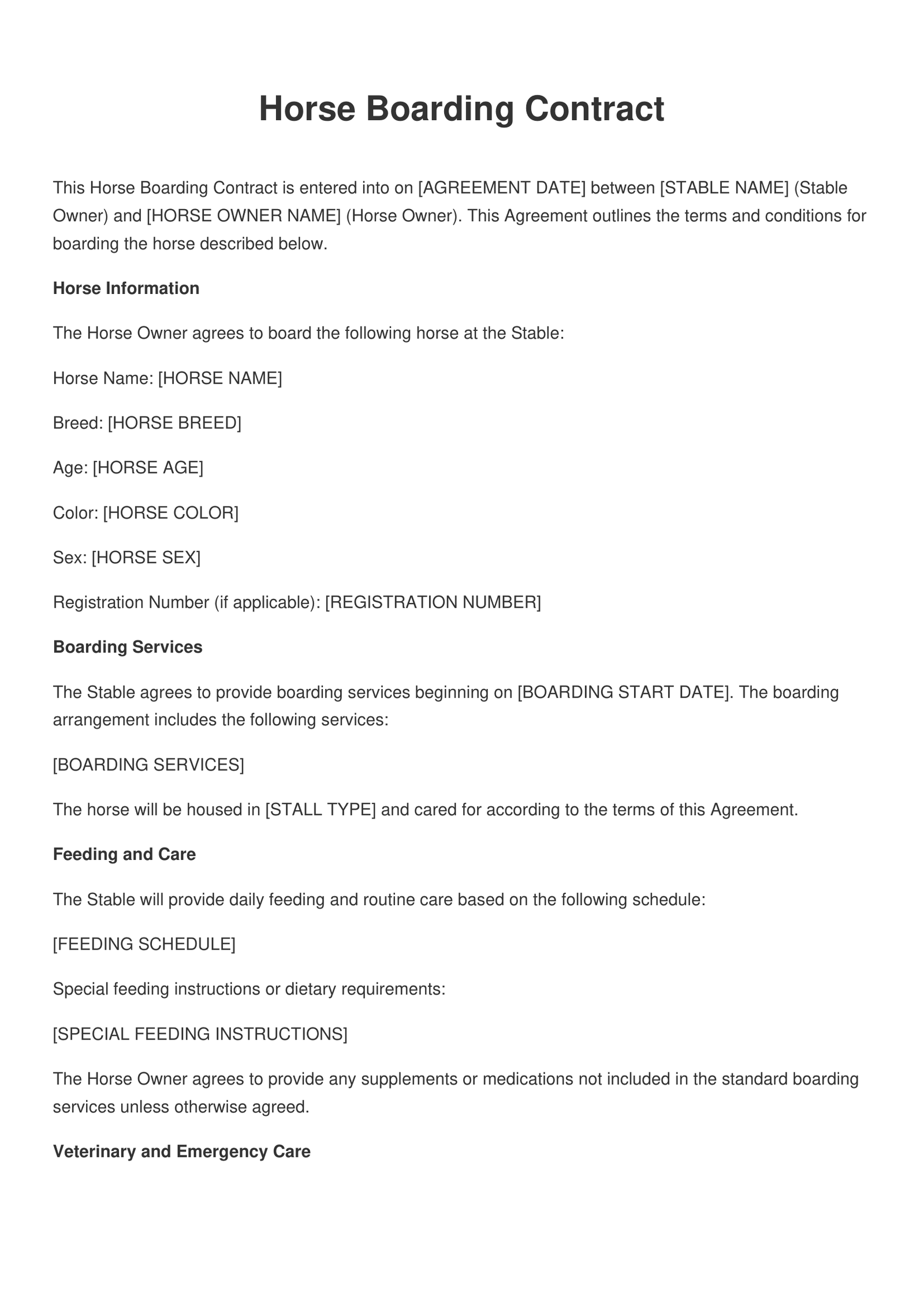
A horse boarding contract is a written agreement between a stable owner (or boarding facility) and a horse owner that spells out the terms under which a horse will be housed, fed, and cared for at the facility. It covers everything from daily feeding schedules and stall type to veterinary authorization, monthly fees, and what happens if either party wants to end the arrangement.
Think of it as the horse-world equivalent of a rental lease — except instead of an apartment, you're entrusting someone with the daily care of a living animal that can't speak up for itself if something goes wrong.
At minimum, a solid boarding contract identifies:
Who is involved — the stable and the horse owner, with full legal names
What horse is being boarded — name, breed, age, color, sex, and registration details
What services are provided — feeding, turnout, stall cleaning, and any add-ons like grooming or exercise
Who pays what, and when — monthly fees, deposits, due dates, and late payment terms
Who's responsible for what — veterinary care, emergencies, supplements, tack, and equipment
How the arrangement can end — notice periods and removal conditions
Why a Boarding Contract Matters
1. It protects the horse. A contract ensures the horse's care isn't left to assumption. Feeding schedules, dietary restrictions, and medical history are documented in writing, so there's no ambiguity about what the horse needs — even if the regular staff member who "just knows the routine" is out sick.
2. It protects the horse owner's financial interests. Boarding fees, deposits, and payment terms in writing prevent disputes over "I thought that was included" or surprise charges. It also defines what happens if fees go unpaid, which matters more than most people expect — unpaid board can lead to liens or even legal claims on the horse in many states.
3. It protects the stable owner from liability. Horses are unpredictable, and working around them carries inherent risk. A well-drafted contract includes a liability release acknowledging that risk, which can be critical if an injury occurs. Many US states have Equine Activity Liability Acts that require specific warning language to appear in the contract for the release to actually hold up in court — so this isn't just boilerplate, it's often a legal requirement.
4. It defines the emergency chain of command. If a horse colics at 2 a.m. and the owner can't be reached, who decides what happens? A contract names the authorized veterinarian and spells out how much authority the stable has to act without prior approval — which can be the difference between a fast, life-saving decision and a costly delay.
5. It sets clear expectations for both sides. Visiting hours, riding arena access, tack storage, general stable rules — these are the small frictions that turn into real conflicts when they're not written down. A contract heads off the "well, nobody told me that" arguments before they start.
6. It gives both parties an exit plan. Relationships between boarders and stables don't always work out. A defined notice period and termination process means either side can walk away cleanly, without an argument over how much notice is "reasonable."
Who Needs One?
Boarding stables and equestrian facilities, to protect the business and standardize terms across all clients
Horse owners, to make sure their horse's care, health, and their own financial exposure are clearly documented
Trainers or barn managers who board horses on behalf of a facility owner
Even boarding a single horse for a friend or family member benefits from a written agreement — informal arrangements are exactly where misunderstandings (and expensive disputes) tend to happen.
The Bottom Line
A horse boarding contract isn't about distrust — it's about clarity. It turns assumptions into agreements, protects the horse at the center of the arrangement, and gives both the stable and the owner a clear reference point if anything goes sideways. Whether you're running a boarding facility or handing your horse over to one, having this in writing isn't optional — it's the foundation the entire relationship stands on.
Ready to use this template?
Download or Customize Your Contract
Fill in the details above, then export your finished contract in one click.
Related Contract Templates
- Wedding Videographer Contract Template - Free PDF, Word & Online Editor
- Boat Rental Contract Template - Free PDF, Word & Online Editor
- Free Wedding Venue Contract Template - Editable PDF, Word & Online
- Florist Contract Template - Free PDF, Word & Online Editor
- Space Rental Agreement Template - Free PDF, Word & Online Editor